Views: 0 Author: Site Editor Publish Time: 2026-11-18 Origin: Site


Choosing the correct chainsaw chain pitch is essential for matching the chain to your guide bar and drive sprocket. Common chainsaw chain pitch sizes include 1/4", .325", 3/8", and .404", each designed for specific chain configurations and equipment requirements. These measurements affect chain compatibility, link spacing, and the overall cutting system design. Understanding the differences between these pitch sizes helps operators identify suitable replacement chains, avoid component compatibility issues, and maintain reliable chainsaw performance.
This guide breaks down the technical definition of chainsaw chain pitch, details the performance differences between the primary sizes, and provides a strict evaluation framework for matching pitch to engine displacement and cutting application.
Technical Definition: Pitch is the exact distance between any three consecutive rivets on the chain, divided by two.
The Compatibility Mandate: A chainsaw chain pitch must perfectly match both the guide bar nose sprocket and the drive sprocket on the powerhead.
Power-to-Pitch Correlation: Pitch size dictates the size and weight of the chain; larger pitches (.404", 3/8") require high-displacement engines (60cc+), while smaller pitches (1/4", .325") are engineered for lower-torque, high-RPM applications.
Cutter Density: Pitch directly impacts how many cutters are on the chain. A smaller pitch means more drive links and cutters for the same bar length, resulting in a smoother cut but requiring more time to sharpen.
Low Profile (LP) Distinction: 3/8" and 3/8" LP (Picco) share the same pitch measurement but have entirely different chassis sizes and power requirements.
Table of Contents
Understanding pitch requires looking at the physical anatomy of the cutting loop. Pitch represents the longitudinal distance along the chain. It dictates the physical size of the drive links, the spacing of the cutters, and the overall mass of the cutting attachment. You cannot mix and match pitch sizes on a single saw without changing the corresponding hardware.
The industry-standard mathematical formula for determining pitch involves measuring the distance between any three consecutive rivets and dividing that number by two. You cannot simply measure the distance between two adjacent rivets. The spacing between a drive link and a cutter link alternates. Measuring across three rivets accounts for this alternating geometry and provides a consistent average distance.
If you measure the distance across three rivets and it equals exactly 3/4 of an inch, dividing that by two gives you 3/8". If the measurement is .650 inches, dividing by two yields .325". This standardized formula ensures universal compatibility across different manufacturers and equipment brands. The measurement tells you exactly how the drive links will mesh with the pockets on your drive sprocket.
Pitch and gauge are two distinct measurements that must work together. Pitch is the longitudinal distance along the chain, determining how the drive links mesh with the sprockets. Gauge is the lateral thickness of the drive link that fits inside the guide bar groove. Common gauge sizes include .043", .050", .058", and .063".
A chain can have the correct pitch but the wrong gauge. If the gauge is too thick, the chain will not fit into the bar. If the gauge is too thin, the chain will slop side-to-side, causing erratic cuts and rapid bar wear. Both metrics must be strictly correct for the equipment to function safely.
Pitch Size | Common Gauge Options | Typical Application |
|---|---|---|
1/4" | .043", .050" | Pole saws, carving saws |
.325" | .050", .058", .063" | Mid-range firewood saws |
3/8" LP | .043", .050" | Homeowner and electric saws |
3/8" Standard | .050", .058", .063" | Professional felling saws |
.404" | .058", .063" | Heavy timber, milling |
Chain pitch determines the spacing between the rivets and the overall size of the chain links. For the same chain length, a smaller pitch generally allows more drive links to fit into the loop. However, the actual number of cutting teeth also depends on the chain configuration, including whether it uses a full-complement or skip-tooth design. When comparing chains, buyers should consider both pitch size and cutter arrangement rather than assuming that a smaller pitch always means more cutting teeth.
Consider a 20-inch guide bar. For example, two 20-inch guide bars designed for different chain pitches may require different drive link counts. A .325" chain and a standard 3/8" chain can have different numbers of drive links even when used with guide bars of the same nominal length. Always check the guide bar specifications to determine the exact drive link count required. The .325" chain packs more cutters into the cut. This higher cutter density yields a smoother finish and reduces vibration, but it also means you have more individual teeth to file during routine maintenance.
Guessing your pitch leads to destroyed sprockets and ruined guide bars. You must identify the exact specifications before ordering replacement parts. There are three primary methods to verify your current setup in the field.
The fastest and most reliable method is to check the guide bar. Manufacturers laser-etch or stamp the exact specifications onto the heel of the guide bar, near where it mounts to the powerhead. You will typically see a sequence of numbers detailing the bar length, pitch, gauge, and drive link count.
A common stamp might read: 20 - 3/8 - .050 - 72DL. This sequence clearly indicates a 20-inch bar requiring a 3/8" pitch chain, a .050" gauge, and a total of 72 drive links. Always wipe away oil and sawdust from the heel of the bar to locate these numbers. If the paint is worn off, you can sometimes use a flashlight held at a low angle to read the stamped indentations in the steel.
If the guide bar stamp has worn off from heavy field use, look directly at the chain. Major manufacturers stamp proprietary identification codes onto the side of the drive links. These numbers serve as a cross-reference for the pitch and gauge.
Manufacturer | Drive Link Stamp | Pitch | Gauge |
|---|---|---|---|
Oregon | 72 | 3/8" | .050" |
Oregon | 20 | .325" | .050" |
Stihl | 3 | 3/8" | Varies by model |
Stihl | 2 | .325" | Varies by model |
Husqvarna | H46 | 3/8" | .050" |
If all stamped numbers are illegible, you can measure the pitch manually using digital calipers. Pull the chain tight to remove slack. Place the tips of the calipers on the center of the first rivet, skip the second rivet, and measure to the center of the third rivet. Divide the resulting decimal by two.
Manual measurement carries a significant margin of error. As a chain wears, clearance can develop between the rivets and connecting links, causing the effective pitch to increase slightly. This means that measurements taken from a heavily worn chain may not accurately represent its original factory specification. For reliable identification, always prioritize the manufacturer's markings or the original chain specifications. Referencing stamped numbers remains the primary recommendation for accuracy. If you must measure, try to measure a section of the chain that hasn't seen extreme tension.
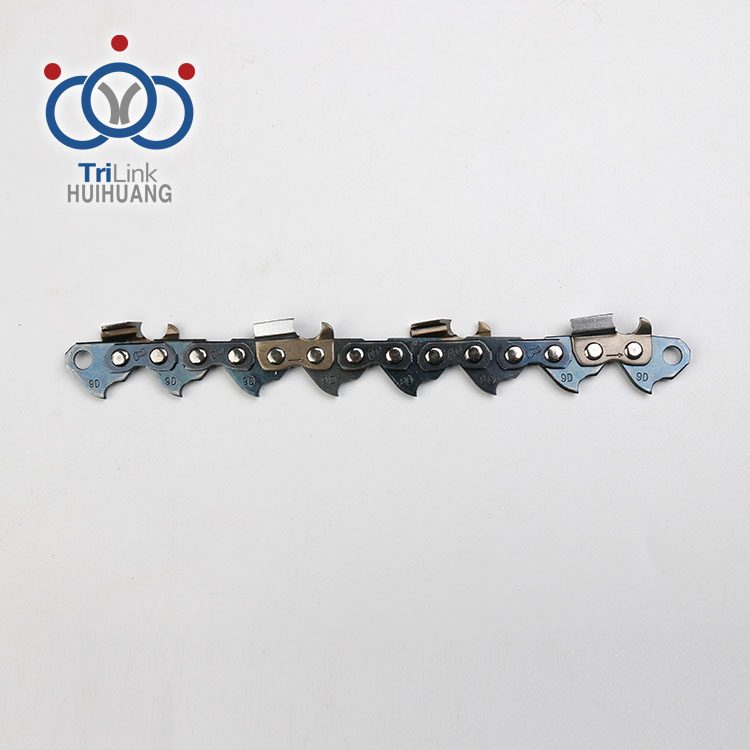
Matching the pitch to the engine displacement ensures the saw operates within its engineered power band. Installing a massive chain on a small engine bogs the motor, while putting a tiny chain on a massive engine risks snapping the chassis.
The 1/4" pitch is the smallest and lightest option available in the handheld market. It features a highly compact chassis designed specifically for low-torque applications. You rarely see this on standard firewood saws.
This pitch is strictly engineered for battery-powered saws and small gas engines under 38cc. You will find it primarily on arborist top-handle saws, pole pruners, and specialty carving saws. The performance profile focuses entirely on precision. Its compact design supports precise cutting and is suitable for detailed pruning and carving applications. The smaller cutters can help operators perform controlled cuts on smaller branches and wood sections, depending on the chain design and cutting conditions. However, it lacks the aggressive bite and chip clearance required for bucking large-diameter wood.
The .325" pitch serves as the workhorse for mid-range equipment. It features a narrower kerf and a lighter chassis than the larger 3/8" standard, allowing for higher chain speeds without overloading the engine.
Engineered for 38cc to 60cc powerheads, the .325" pitch excels in firewood processing, farm and ranch maintenance, and light felling. It balances cutting speed with power efficiency. On a 50cc saw, a .325" chain often cuts faster than a 3/8" chain because it draws less power, preventing the engine from bogging down in the cut. Because of the smaller pitch size, it features more cutters per inch than 3/8". This yields a smoother cut but requires slightly more time to hand-file in the field.
The 3/8" category causes the most confusion because it encompasses two entirely different chassis sizes: 3/8" Standard and 3/8" Low Profile (often called Picco or LP). You cannot interchange them. They require different sprockets and different guide bars.
It is commonly used on selected homeowner chainsaws, pole saws, and electric chainsaws, depending on the equipment manufacturer's specifications. It reduces the power required to pull the chain through the wood, making it ideal for electric saws and small yard maintenance tools. The cutters are physically shorter, which reduces the bite angle and keeps small engines in their power band.
3/8" Standard features large, heavy cutters and a robust chassis. It requires significant engine torque to maintain RPM in the cut. It is engineered for professional logging saws ranging from 60cc to 100cc. The primary applications include professional felling, heavy firewood bucking, and chainsaw milling. The performance profile is highly aggressive, clearing massive wood chips efficiently in large-diameter cuts.
The .404" pitch is the largest, heaviest, and most aggressive pitch used in handheld equipment. It is built for extreme abuse and massive timber. You will only find this on the largest saws on the market.
This pitch is strictly reserved for 85cc+ powerheads, such as the Stihl MS 881 or Husqvarna 3120 XP. Primary applications include extreme chainsaw milling, felling massive old-growth timber, and light mechanized harvesters. It offers maximum durability and massive chip clearance. The heavy chassis is highly resistant to stretching and breakage under extreme loads. However, it causes severe operator fatigue and carries a very high kickback risk.
Note: You may occasionally hear about 3/4" pitch. This is strictly reserved for heavy industrial mechanized processors and is never used on handheld saws.
Selecting the optimal pitch requires balancing engine power against cutting goals. Deviating from the manufacturer's recommendations requires a clear understanding of mechanical trade-offs. You must evaluate your powerhead before making any changes.
Engine displacement is an important factor when selecting a chainsaw chain pitch, but it should not be used as the only selection criterion. Different chainsaw models are designed for specific combinations of chain pitch, guide bar, drive sprocket, and chain configuration. Using a chain that exceeds the intended cutting system specifications may increase mechanical stress and reduce cutting efficiency. Similarly, selecting a chain that is not designed for the saw can result in compatibility and performance problems. Always follow the manufacturer's recommended chain specifications before changing the original setup.
Conversely, under-pitching a saw carries catastrophic risks. Putting a lightweight .325" chain on an 80cc professional felling saw overwhelms the chain chassis. The massive torque of the engine can easily snap the smaller drive links during a heavy cut, sending metal shrapnel toward the operator. Always match the chassis strength to the engine output.
Kerf width, or the actual width of the cut made in the wood, depends primarily on cutter geometry, chain gauge, and the overall cutting system design rather than chain pitch alone. A larger pitch like 3/8" standard creates a wider kerf, removing more wood fiber per pass. This provides aggressive chip-clearing capacity, which is essential when bucking 30-inch oak logs. However, a wider kerf requires more horsepower to push the teeth through the timber.
Smaller pitches like .325" create a narrower kerf. They remove less wood fiber, allowing the engine to maintain higher RPMs. For limbing and processing medium-sized firewood, a narrower kerf often results in faster overall cutting speeds because the saw stays in its optimal power band. You spend less time fighting the wood and more time letting the saw do the work.
Cutter density impacts your field maintenance schedule. A smaller pitch means more teeth on the loop. If you run a 20-inch bar with a .325" chain, you have roughly 39 cutters to sharpen. If you run a 20-inch bar with a 3/8" chain, you only have 36 cutters to sharpen. While three teeth may not sound significant, the time adds up during heavy field use.
Larger pitches use larger files, which remove material faster during hand-filing. The required file diameter depends on the chain model and cutter specifications, not just the chain pitch. Always refer to the chain manufacturer's sharpening recommendations to select the correct file size and maintain the proper cutting angle. You must stock the correct file sizes for your specific pitch, or you will ruin the cutting angle of the teeth.
You cannot simply buy a different pitch chain and throw it on your current saw. Changing the pitch requires a complete mechanical conversion. You must purchase a new rim or spur sprocket for the clutch drum, and you must purchase a new guide bar with a matching nose sprocket.
Consider the mechanical benefits before converting a saw. Upgrading a 60cc saw from .325" to 3/8" makes sense if you primarily fell large hardwoods and need aggressive chip clearance. If you run a rim sprocket system, swapping the rim is straightforward. If you run a spur sprocket, you must replace the entire clutch drum. If the saw performs well with its factory .325" setup, the conversion rarely justifies the effort for casual firewood cutters.
Forcing a mismatched chain onto a saw is not a harmless mistake. It results in immediate mechanical destruction and severe physical danger. The components are engineered to mesh with zero tolerance for error.
The drive links of the chain must seat perfectly into the pockets of the drive sprocket and the teeth of the bar nose sprocket. If you put a 3/8" chain on a .325" sprocket, the spacing is entirely wrong. The drive links will ride up on the points of the sprocket star rather than seating in the pockets.
This mismatch causes rapid metal wear. Within minutes of operation, the hardened steel of the drive links will chew the sprocket to pieces, creating deep burrs. The chain will bind, stretch violently, and immediately derail from the guide bar groove. You will ruin the chain, the bar, and the sprocket simultaneously. The drive link tangs will become peened over, preventing them from ever fitting into a bar groove again.
Mechanical destruction is expensive, but the safety hazards are life-threatening. When a mismatched chain fails to seat in the sprocket, it operates under extreme, uneven tension. An improperly matched chain may not engage correctly with the sprockets, resulting in abnormal tension, excessive wear, or chain derailment. These mechanical failures can create serious operator safety hazards, making it essential to use a chain that matches the manufacturer's specified pitch and equipment configuration.
Incorrect pitch alters the saw's engineered kickback reduction geometry. Saws are balanced for specific chain weights and cutter aggressiveness. Running an oversized pitch on a lightweight saw drastically increases the rotational force during a kickback event, making the saw much harder to control when the bar nose strikes a solid object. Always respect the factory specifications.
The correct chainsaw chain pitch is almost always dictated by the saw's engine displacement and the manufacturer's original specifications. While modifications are possible for specific professional applications, adhering to the factory pitch guarantees the best balance of cutting speed, engine longevity, and operator safety.
To replace a chain safely, follow a strict shortlisting logic: First, read the guide bar stamp to identify the factory pitch. Second, verify the drive link code on your old chain to confirm it matches the bar. Finally, ensure the new chain matches the existing drive sprocket on the powerhead.
Take these actionable next steps before installing your new chain:
Inspect your drive sprocket for deep wear grooves. A worn sprocket will rapidly destroy a brand-new chain even if the pitch is perfectly matched.
Clean the guide bar groove thoroughly with a putty knife to ensure the new drive links seat properly.
Verify that the gauge of your new chain matches the bar, as pitch alone does not guarantee a proper fit.
Check the chain tension after the first five minutes of cutting, as new chains experience initial stretch as the rivets settle.
A: Yes, you can change the pitch, but it requires a complete mechanical conversion. You must replace the drive sprocket on the engine and the guide bar simultaneously so that all three components share the exact same pitch measurement.
A: The better option depends on your chainsaw model, manufacturer specifications, and cutting requirements. A .325" chain is commonly used on mid-range chainsaws, while a standard 3/8" chain is often found on larger professional saws. However, engine displacement alone does not determine compatibility. Always check the recommended chain pitch, gauge, guide bar, and drive sprocket specifications.
A: 3/8 LP stands for Low Profile. It shares the same 3/8" rivet spacing as a standard chain but features a much smaller, lighter chassis and smaller cutters. It is engineered specifically for low-horsepower, entry-level consumer saws and electric chainsaws.
A: The most reliable method is to check the stamped numbers on the heel of your guide bar. Alternatively, look at the manufacturer codes stamped on the chain's drive links. For example, an Oregon chain stamped with "72" is 3/8, while "20" indicates .325.
A: Yes. Pitch influences the kerf width and cutter size. A smaller pitch creates a narrower cut, allowing smaller engines to maintain high RPMs for faster cutting. A larger pitch removes more wood per pass but requires significant engine torque to prevent bogging down.