Views: 0 Author: Site Editor Publish Time: 2026-11-18 Origin: Site


Choosing the correct chainsaw chain gauge is essential for ensuring proper compatibility between the saw chain and guide bar. The four common gauge sizes, .043", .050", .058", and .063", refer to the thickness of the drive links that fit into the guide bar groove. Even small differences in gauge can affect chain fit, stability, and overall cutting system compatibility. Understanding these measurements helps operators identify the correct replacement chain, avoid premature component wear, and maintain safe and reliable chainsaw operation.
This guide breaks down exactly what chainsaw chain gauge is and how it functions mechanically. We explain how the four common gauge sizes affect compatibility across different chainsaw and guide bar configurations. You will learn precise methods for identifying your current gauge to ensure a safe, exact-fit replacement. Understanding these metrics eliminates guesswork and keeps your equipment running smoothly.
Gauge Defined: Chainsaw chain gauge is the exact thickness (or density) of the drive links—the bottom teeth that ride inside the guide bar groove.
Zero Margin for Error: The chainsaw chain gauge must perfectly match the guide bar. Running a thinner chain in a wider groove causes dangerous wobble and tensioning failures; running a thicker chain in a narrow groove is physically impossible.
Sprocket Independence: Drive sprockets are pitch-dependent, not gauge-dependent. You can change your saw's gauge by swapping the bar and chain without replacing the sprocket.
Standardization: .050" is the most common consumer standard, while .063" dominates heavy-duty professional saws (particularly Stihl).
Table of Contents
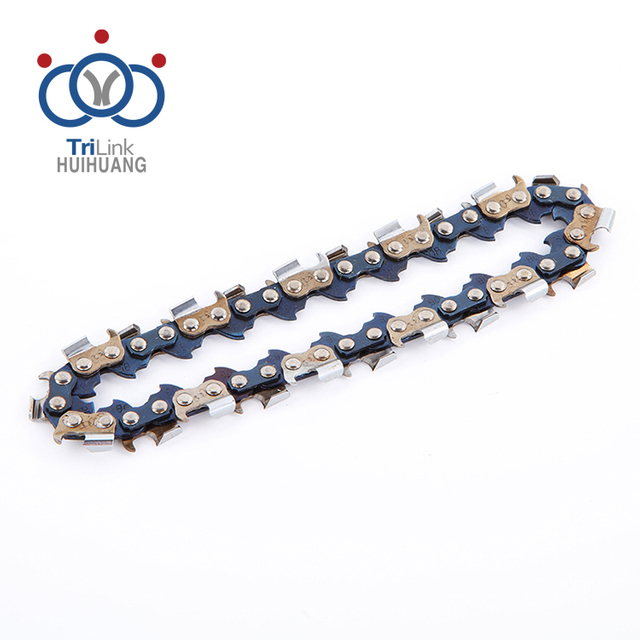
To understand gauge, you must look at the specific anatomy of the cutting system. A standard chainsaw chain consists of cutters, tie straps, and drive links. The drive link is the lower component of a chainsaw chain that fits into the groove of the guide bar. It serves two essential functions. First, it engages with the drive sprocket to transfer power from the chainsaw engine or motor to the chain. Second, it runs inside the guide bar rails, helping guide the chain along its cutting path. Its thickness determines the chain gauge and must match the width of the guide bar groove.
Chain gauge refers to the thickness of the drive link section that fits inside the guide bar groove, rather than the overall size or density of the chain. It does not measure the top of the link, the rivets, or the cutting teeth. Manufacturers machine this lower section to exact thousandths of an inch. This precision machining dictates how much metal occupies the space inside the bar rails, directly impacting the structural integrity of the drive link under heavy torque. When you force a saw through dense oak, the drive link takes the brunt of the rotational force. The thickness of that metal determines whether the chassis holds together or snaps.
The cutting system operates on a strict male-to-female connection protocol. The drive link acts as the male connector. The guide bar provides the female groove. This relationship requires incredibly tight tolerances to function safely at high RPMs. The metal must fit snugly enough to prevent lateral movement but remain loose enough to glide without friction.
This tight tolerance is mandatory for proper lubrication. The chainsaw's lubrication system supplies bar oil to the guide bar, where it helps reduce friction between the moving chain and the guide bar rails. As the chain moves, the oil spreads along the contact surfaces to support proper lubrication and reduce heat buildup and premature wear. A perfect match ensures stability during plunge cuts, prevents the cutters from chattering, and delivers a smooth, straight cut through dense timber. If the groove pinches the link, the metal overheats, turns blue, and ruins the temper of the steel.
Gauge is just one piece of the puzzle. Finding a perfect fitting replacement requires four specific numbers. Operators often confuse these metrics, leading to incompatible purchases. You must isolate the technical evaluation criteria to ensure proper fitment. Getting three out of four correct still leaves you with a useless loop of metal.
Pitch measures the distance between any three consecutive rivets divided by two. It dictates the size of the drive sprocket. Drive link count is the total number of drive links in the loop, determining the overall length. Cutter type refers to the shape of the cutting tooth, such as full chisel or semi-chisel. Gauge stands alone as the measurement of drive link thickness. You can have two loops with the exact same pitch, length, and cutter type, but if the gauge differs, they are completely incompatible with the same guide bar.
The forestry industry relies on four standardized thicknesses. Understanding the application for each size helps operators match their equipment to the specific demands of the job site.
Gauge (Inches) |
Gauge (mm) |
Primary Application |
Performance Characteristic |
|---|---|---|---|
.043" |
1.1mm |
Battery saws, pole pruners |
Low rotational mass, high efficiency |
.050" |
1.3mm |
Homeowner, farm, light pro |
Industry standard, wide availability |
.058" |
1.5mm |
Mid-size pro logging |
High tensile strength, resists stretching |
.063" |
1.6mm |
Heavy felling, Alaskan milling |
Maximum durability, superior oil carry |
The .043-inch gauge represents the thinnest standard drive link on the market. Manufacturers design this size specifically for lightweight applications where power conservation is a priority. You will find this gauge predominantly on modern battery-powered saws, electric models, and lightweight gas pole pruners used by residential landscapers.
The performance profile of the .043 gauge centers on efficiency. Because the drive links are thinner, the entire chassis weighs less. This requires significantly less power from the motor to achieve optimal chain speed. These systems utilize narrow kerf cutting teeth to remove less wood per pass, maximizing battery runtime and reducing operator fatigue during overhead pruning tasks. The reduced drag allows small electric motors to punch above their weight class.
However, this thin profile comes with strict limitations. The .043 gauge lacks the physical mass to withstand heavy torque. It is highly susceptible to stretching, bending, and snapping if pinched in a heavy log. Operators must avoid using this gauge for felling large trees or cutting dense, seasoned hardwoods. If a branch shifts and binds the bar, yanking the powerhead will easily bend the 1.1mm drive links, rendering the loop useless.
The .050-inch gauge dominates the global market. It serves as the undisputed industry standard for the vast majority of homeowner, farm, and light professional equipment. Brands like Husqvarna, Echo, Poulan, and Makita utilize this size across their mid-range lineups. If you buy a saw off the shelf at a big box hardware store, it likely runs a .050 setup.
This gauge offers an ideal balance between durability and weight. The 1.3mm thickness provides enough tensile strength to handle aggressive cutting tasks, firewood bucking, and storm cleanup without bogging down 40cc to 60cc powerheads. The drive links resist stretching far better than the .043 variants while remaining light enough to maintain high RPMs in the cut.
The primary advantage of running a .050 setup is aftermarket availability. Because it is the most common size, operators can easily find replacement parts, guide bars, and specialized cutter profiles at any local hardware store or dealership. This ubiquity makes it the most versatile choice for general-purpose property maintenance. You never have to special-order a .050 loop.
The .058-inch gauge occupies a specific niche in the professional logging and forestry sectors. Historically, this size served as the standard for mid-to-large displacement professional saws in European markets. While less common on consumer retail shelves today, it remains a staple for professional arborists running 60cc to 80cc powerheads.
The performance profile of the .058 gauge focuses on increased tensile strength. The jump from 1.3mm to 1.5mm adds significant metal mass to the drive link. This extra density prevents the chassis from stretching under the sustained heat and heavy loads of commercial timber harvesting. It bridges the gap perfectly for operators who need more durability than a .050 can provide, but want to avoid the full rotational weight penalty of a .063 setup.
Operators running long guide bars (24 to 28 inches) often prefer .058 for its stability. The thicker drive links seat firmly in the bar rails, reducing vibration and cutter chatter when burying the bar in large diameter oak or beech. The added width also helps clear sawdust out of the longer bar grooves more effectively than thinner gauges.
The .063-inch gauge is the heaviest, thickest standard size available. Manufacturers reserve this gauge for extreme applications requiring maximum durability. It is the standard configuration for large felling saws, Alaskan milling setups, and the vast majority of mid-to-large Stihl professional equipment.
This gauge excels in high-torque environments. The 1.6mm drive links possess massive tensile strength, making them nearly impervious to stretching, even when subjected to the extreme heat generated by chainsaw milling. When a 90cc powerhead drives a 36-inch bar through a solid slab of hardwood, the .063 gauge ensures the chassis remains intact. The rivets hold tighter, and the tie straps resist the lateral forces that would tear a smaller chassis apart.
Beyond raw strength, the .063 gauge offers superior oil retention. The thick drive links feature deep oil holes and a large surface area. They act like scoops, pulling massive volumes of bar oil from the reservoir and carrying it down the length of oversized guide bars. This enhanced lubrication prevents rail burnout on bars exceeding 30 inches, especially when running thick winter-grade bar oil in freezing temperatures.
The fastest and most accurate way to identify your gauge is to read the factory stamping on the guide bar. Manufacturers laser-etch or stamp the exact technical specifications directly into the metal. You will typically find this information near the heel of the guide bar, right where it mounts to the powerhead.
Locate the cluster of numbers on the motor side of the bar. You may need to wipe away packed sawdust and bar oil to reveal the text. Look for formatting that explicitly lists the thickness. It usually appears as "1.3mm / .050" or simply ".050". This number is almost always listed directly next to the pitch (e.g., 3/8) and the drive link count (e.g., 72 DL). If the bar is relatively new, this stamp provides definitive proof of your required gauge. Always trust the bar stamp over the saw's manual, as previous owners may have swapped the bar.
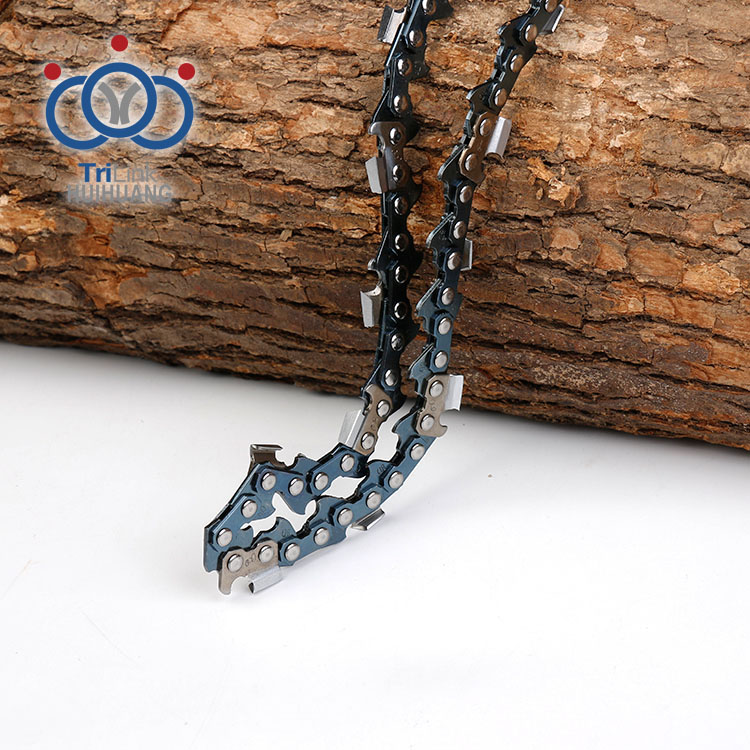
Guide bar stamps wear off over time. Friction, sap, and heavy use can erase the laser etching completely. When the bar is illegible, you must look at the drive links themselves. Major manufacturers stamp single-digit identification codes directly onto the side of the drive links to indicate the gauge.
You must cross-reference these stamped numbers with a standard identification chart based on the brand of the cutting loop. The codes vary wildly between manufacturers. Clean a section of the loop with a wire brush and inspect the drive links under good lighting. Once you find the stamped number, verify the brand logo on the tie straps to ensure you are decoding the correct manufacturer's system.
Manufacturer |
.043" Code |
.050" Code |
.058" Code |
.063" Code |
|---|---|---|---|---|
Oregon |
3 (with 3/8 LP) |
0 |
8 |
3 (with standard 3/8) |
Stihl |
1 |
3 |
5 |
6 |
Carlton |
N4C |
A1 |
A2 |
A3 |
Oregon uses a specific numbering system. A "3" indicates .043. A "0" indicates .050. An "8" indicates .058. A "3" is also used for .063. Because Oregon uses "3" for both 3/8 LP .043 and standard 3/8 .063, you must use the context of the pitch and the physical size of the chassis to differentiate them. Stihl utilizes a more straightforward sequential system. A "1" indicates .043. A "3" indicates .050. A "5" indicates .058. A "6" indicates .063.
When bar stamps are worn off and drive link codes are illegible or missing, you must measure the metal directly. Do not use a tape measure or a standard ruler. These tools are insufficiently precise for measuring thousandths-of-an-inch tolerances. You must use digital calipers.
Remove the loop from the saw and clean it thoroughly with a solvent. Packed dirt and dried sap will artificially inflate the measurement.
Locate a drive link that shows minimal wear. Avoid measuring links that have burrs, mushrooming, or heavy friction damage from a pinched bar.
Close the caliper jaws firmly around the clean, unworn bottom tip of the drive link. Ensure the jaws sit flat against the metal sides.
Read the digital output. It will display 1.1mm (.043), 1.3mm (.050), 1.5mm (.058), or 1.6mm (.063).
This measurement can provide a reference for identifying drive link thickness, but normal wear may affect the accuracy of measurements taken from used chains. Do not determine the original gauge by rounding up a worn chain's measured thickness. Instead, check the original chain identification code, guide bar specifications, or manufacturer documentation to confirm the correct replacement gauge.
A persistent myth in the forestry community suggests that a thicker gauge results in a wider cut (kerf) and slower cutting speeds. This is fundamentally incorrect. Gauge dictates the thickness of the drive link that rides inside the bar, not the width of the cutter teeth on top.
The cutters are all manufactured to the same width for a given pitch, regardless of the drive link thickness. If you take a 3/8 pitch .050 loop and a 3/8 pitch .058 loop, the cutting teeth are identical in size. They remove the exact same amount of wood per pass. Therefore, a .050 and a .058 setup of the same pitch and cutter profile will cut at the exact same speed. The kerf width remains unchanged. The only exception is narrow kerf systems, which are specifically engineered with smaller cutters and paired with .043 gauge to reduce drag.
While cutting speed remains identical, gauge does impact the overall weight and rotational dynamics of the cutting system. Heavier gauges, specifically .063, add significant metal mass to the chassis. This increases the rotational weight that the powerhead must spin.
On low-CC saws, this added mass slows acceleration and throttle response. The motor has to work harder to get the heavier metal moving. However, on high-CC professional saws, this weight difference is negligible. The trade-off is raw durability. The heavier mass prevents chain breakage, chassis stretching, and rivet failure when cutting dense hardwoods or operating in dirty, abrasive conditions. A heavy gauge absorbs shock loads that would snap a thinner chassis.
Gauge plays a massive role in thermal management and lubrication. The drive links act as the delivery mechanism for bar oil. Thicker drive links (.058 and .063) possess larger surface areas and deeper oil reservoirs machined into the metal.
This larger surface area pulls significantly more bar oil from the powerhead reservoir into the bar rails. The increased fluid volume improves cooling and reduces friction. This dynamic becomes highly apparent on guide bars over 24 inches. A thin .050 drive link struggles to carry enough oil to the nose sprocket of a 36-inch bar, leading to overheating. The thicker .063 links ensure a constant, heavy oil film reaches the end of the longest bars, preventing catastrophic rail failure during sustained felling operations.

Mismatched equipment guarantees mechanical failure. Attempting to run a thinner .050 gauge inside a wider .058 or .063 guide bar groove introduces severe immediate and long-term risks. The drive links lack the physical width to seat snugly against the bar rails.
The immediate risk is lateral instability. The cutters lean side-to-side (wobble) during the cut. This lateral movement causes the saw to cut in a curved line, leading to severe binding in the log. The operator loses precision control over the felling direction. The saw will constantly pull to one side, making straight bucking cuts impossible.
The long-term damage destroys the guide bar. As the thin drive links thrash side-to-side, they hammer against the inside of the rails. This causes accelerated "V-shaped" wear, permanently widening and ruining the bar groove. Furthermore, this sloppy fit creates a massive risk of derailment. The chassis easily jumps out of the bar at high RPMs. A thrown loop whips back toward the operator, creating a lethal hazard.
Mismatched gauges completely prevent correct tensioning protocols. A cutting loop must be properly tensioned to operate safely. It should snap back into the rails when pulled down slightly.
If you place a thin gauge in a wide groove, the lateral slop makes proper tensioning impossible. You can tighten the tensioner screw all the way, but the chassis still wobbles loosely side-to-side. A loose, wobbling chassis cannot cut smoothly. It catches aggressively in the wood, drastically increasing the risk of violent kickback. Operating a saw that cannot hold proper tension violates basic safety standards and guarantees equipment damage.
Operators often ask if they are permanently locked into the gauge their saw came with from the factory. The answer is no. You can change your saw's gauge, but you must understand how the components interact.
Gauge is dictated entirely by the guide bar. If you want to switch from a .050 setup to a thicker .058 setup for increased durability, you must perform a complete bar and chain swap. You buy a .058 guide bar and a matching .058 cutting loop. They must be replaced as a matched set.
You do not need to replace the drive sprocket. Drive sprockets care exclusively about pitch, not gauge. The rim or spur sprocket engages the bottom of the drive link, regardless of its thickness. A 3/8" pitch drive sprocket drives a 3/8" .050 loop, a 3/8" .058 loop, or a 3/8" .063 loop equally well. As long as the pitch matches the sprocket, you are free to change the gauge by swapping the bar and loop assembly.
Chainsaw chain gauge is a strict compatibility requirement. The thickness of the drive links must match the width of the guide bar groove with zero exceptions. Attempting to mix and match sizes results in ruined equipment, poor cutting performance, and severe safety hazards. Maintaining exact tolerances ensures proper lubrication, prevents derailment, and keeps the cutting system stable under heavy loads.
Clean the heel of your guide bar and locate the laser-etched specifications to confirm your current gauge before ordering parts.
Remove the loop, clean a drive link, and measure the bottom tip with digital calipers if the bar stamp is illegible.
Verify the remaining three metrics—pitch, drive link count, and cutter type—once the gauge is confirmed to secure the perfect replacement.
Purchase the guide bar and cutting loop as a matched set if you decide to upgrade to a heavier gauge for increased durability.
A: No. The .050 drive links are 1.3mm thick and will physically not fit into the 1.1mm groove of a .043 guide bar. The metal is too wide to enter the rails. You must match the gauge exactly to ensure the drive links seat properly and glide without friction.
A: No. Drive sprockets are specific to the chain's pitch. The gauge only needs to match the guide bar. A 3/8" pitch sprocket will drive any 3/8" pitch loop, regardless of whether the gauge is .050, .058, or .063. The sprocket engages the spacing, not the thickness.
A: For consumer and light commercial saws, .050" (1.3mm) is the industry standard. You will find it on most Husqvarna, Echo, and Poulan models. For professional and heavy-duty applications, .063" (1.6mm) is used in selected chainsaw and guide bar configurations. The actual gauge depends on the specific saw model and compatible cutting attachment.
A: Check the stamp on the heel of the guide bar first. If worn, look for a manufacturer code stamped on the drive links and cross-reference a chainsaw chain identification chart. Alternatively, measure the clean bottom tip of a drive link with digital calipers to find the exact thickness in millimeters.
A: STIHL and Husqvarna both offer chainsaw chains with different gauge specifications, depending on the saw model, guide bar configuration, and intended application. Neither brand uses a single gauge across its entire product range. Always check the guide bar markings, original chain specifications, and manufacturer compatibility information before purchasing a replacement chain.
A: To find an exact fit, you need the pitch, the gauge, the drive link count, and the cutter type/profile. The pitch is the distance between rivets. The gauge is the drive link thickness. The drive link count is the total length. The cutter type is the tooth profile.