Views: 0 Author: Site Editor Publish Time: 2026-07-17 Origin: Site


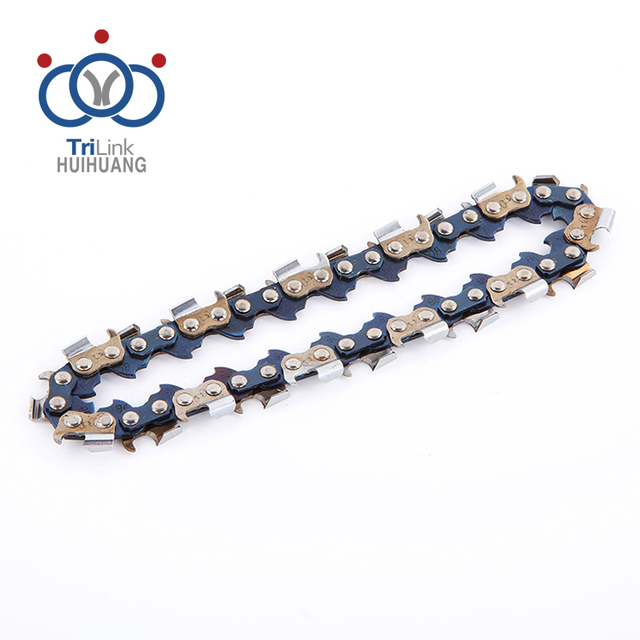
A chainsaw powerhead is essentially useless without the correct chain attached to the guide bar. Spinning at speeds that can reach up to 60 mph, the chain serves as the primary point of contact with the wood. It dictates your cutting efficiency, your overall safety, and the longevity of your equipment. Using the wrong chain leads to poor performance, severe damage to the guide bar, or dangerous kickback events.
Selecting a replacement or upgrade Chainsaw Chain requires navigating a strict matrix of non-interchangeable specifications. You must balance cutter profiles against specific wood conditions, match the chain to your powerhead type, and consider your own operator experience level. A mismatch in pitch, gauge, or drive links means the chain simply will not fit or function safely.
This guide breaks down essential chainsaw chain terminology. It provides a clear framework for matching chain specifications to your guide bar and power source. We evaluate the trade-offs between different cutter styles and safety profiles to ensure you make the right choice for your cutting needs.
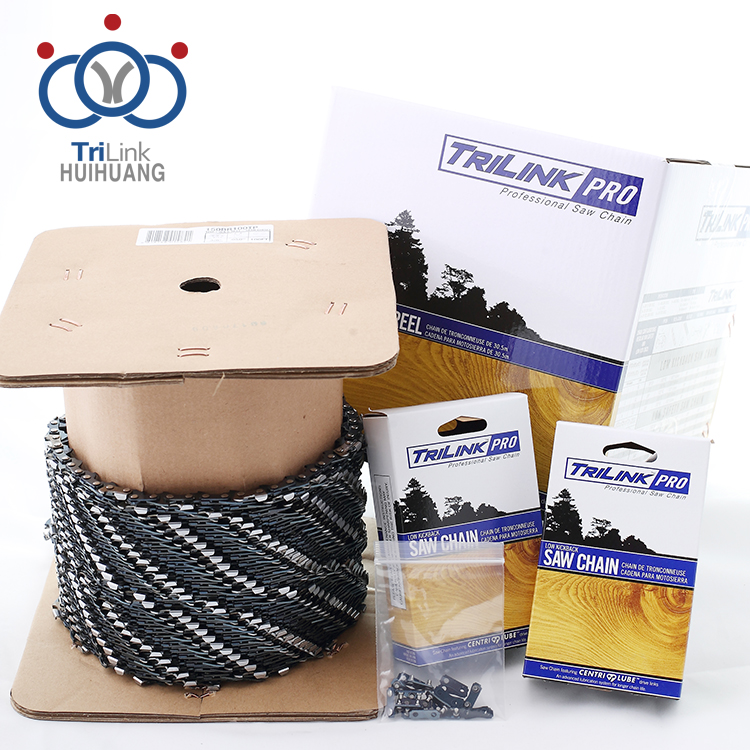
Strict Compatibility: A chainsaw chain must exactly match the saw’s pitch, gauge, and drive link count; these are non-negotiable specifications dictated by the guide bar and drive sprocket.
Power Source Optimization: Modern battery-powered chainsaws require specialized narrow-kerf chains to reduce drag and maximize battery runtimes, whereas high-displacement gas saws require heavy-duty standard-kerf chains.
Cutter Profile Trade-offs: Full-chisel chains offer maximum cutting speed in clean timber, while semi-chisel chains sacrifice absolute speed for superior edge retention in dirty or frozen wood.
Safety Classifications: Chains are categorized by kickback potential (ANSI standards); low-kickback (green label) chains are engineered with safety bumpers for consumers, whereas standard (yellow label) chains are restricted to trained professionals.
Maintenance Dictates Lifespan: Even the highest-quality chain requires precise tensioning, correct file-to-cutter matching, and frequent, angle-specific sharpening to prevent premature bar wear and hazardous kickback.
Table of Contents
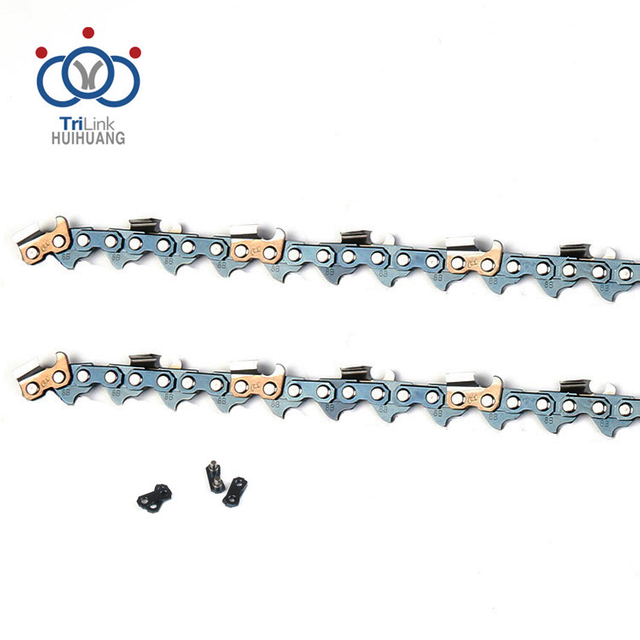
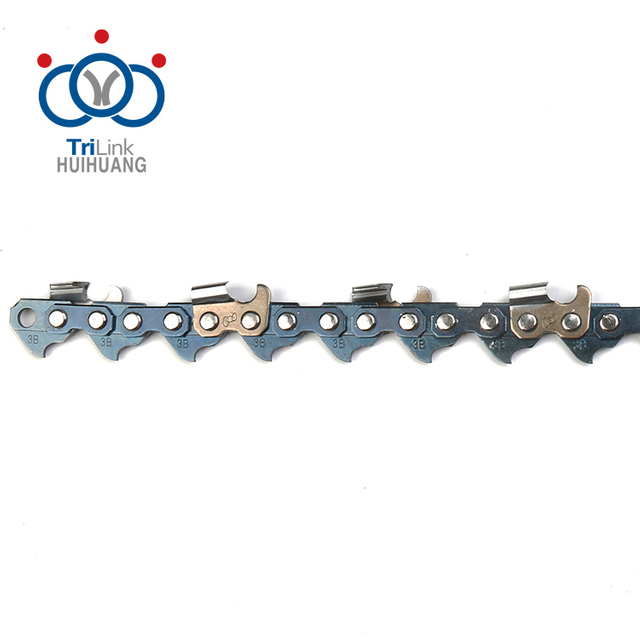
Buyers cannot properly evaluate chain options without understanding how individual components interact. The chain must work seamlessly with the saw, the guide bar, and the wood you are cutting. Knowing these parts helps you identify wear and choose the right replacement when you are out in the field.
The drive link is the bottom part of the chain that rides inside the guide bar groove. It engages with the drive sprocket to propel the chain forward. Drive links also help clear sawdust and debris from the groove while distributing bar oil evenly to reduce friction. If you look closely at a drive link, you will notice a small hole or indentation designed specifically to catch and carry bar oil around the entire length of the guide bar.
Tie straps hold the chain chassis together on the sides. They are secured by rivets, which act as pivot points. These rivets allow the chain to flex smoothly as it travels around the bar nose and over the drive sprocket. When a chain breaks in the field, it is almost always due to a failed rivet or a cracked tie strap caused by improper tensioning or lack of lubrication.
The cutter is the sharpened tooth that severs the wood fiber. Directly in front of each cutter sits a depth gauge, commonly called a raker. The depth gauge dictates the exact thickness of the wood chip removed per pass. If the raker is too high, the cutter cannot bite into the wood. If it is too low, the cutter grabs too much wood, causing the saw to bog down, vibrate violently, or kick back toward the operator.
Many chains incorporate structural additions designed to improve safety. Bumper drive links or specially angled tie straps help deflect debris. They prevent the cutter from snagging too deeply in the kickback zone at the upper quadrant of the bar nose. These features are standard on consumer chains but are often removed on professional chains to allow for bore cutting.
Component | Primary Function | Field Inspection Tip |
|---|---|---|
Drive Link | Engages sprocket, clears groove, carries oil | Check for burrs or peening on the bottom edge |
Tie Strap | Connects drive links and cutters | Look for hairline cracks near the rivet holes |
Rivet | Acts as a pivot point for chain flexibility | Ensure heads are flush and not excessively worn |
Cutter | Severs wood fibers | Check witness mark to ensure adequate tooth length remains |
Depth Gauge | Controls chip thickness | Measure with a depth gauge tool to ensure proper clearance |

To physically fit a chain to a chainsaw, you must evaluate three strict technical dimensions. Guessing these measurements will result in a chain that derails, damages your saw, or fails to mount entirely. You cannot force a mismatched chain to work.
Pitch is defined as the distance between any three consecutive rivets divided by two. Common pitch sizes include 1/4", .325", 3/8", and .404". The pitch of the chain must perfectly match both the drive sprocket on the powerhead and the sprocket in the bar nose. If you try to run a .325" chain on a 3/8" sprocket, the drive links will not seat properly, instantly destroying the sprocket and the chain.
Gauge refers to the thickness of the drive link portion that fits inside the bar groove. Standard gauges are .043", .050", .058", and .063". Mismatching the gauge causes severe implementation risks. A chain that is too thick will not fit into the bar groove. A chain that is too thin will slop side to side, cutting erratically and causing severe bar rail damage or chain derailment.
Measuring chain length in inches is highly inaccurate. Different brands require different link counts for the same stated bar length. For example, one 20-inch bar might require 72 drive links, while another requires 74. Counting the drive links (DL) is the only reliable method for sizing your chain correctly.
You can usually find the required specifications stamped on the heel of the guide bar near the powerhead. You will see numbers like "3/8 .050 72DL". If the bar markings have worn off from heavy use, look for manufacturer-specific ID codes stamped directly on the drive links. You can cross-reference these codes online or at a dealer to find the exact pitch and gauge.

The kerf is the width of the cut made by the chain's cutters. Choosing the right kerf width depends heavily on the power source of your chainsaw. You must match the chain's cutting profile to the engine's torque output.
Standard-kerf chains remove a wider path of wood and require more power to pull through the cut. They are built with thicker chassis components to handle high torque. Narrow-kerf chains feature thinner cutters and drive links, usually running on a .043" gauge. They remove less wood per pass, which translates to less resistance.
Narrow-kerf chains are critical for cordless battery-powered chainsaws. Because they remove less wood, they reduce friction and motor drag. This efficiency significantly extends battery runtimes and prevents the electric motor from overheating during sustained cuts. If you put a standard kerf chain on a battery saw, you will drain the battery in minutes and likely trigger the thermal overload protection.
High-displacement gas chainsaws generate massive torque. They require standard-kerf chains to withstand higher tension and cutting forces. A narrow-kerf chain on a large 70cc gas saw risks snapping or wearing prematurely under heavy loads. The sheer pulling force of a large gas engine will stretch a narrow-kerf chain beyond its usable limit very quickly.
Different cutter shapes offer specific advantages based on the application, cutting speed, and maintenance requirements. Selecting the right profile depends on what and where you are cutting. There is no single best cutter profile for every situation.
Full-chisel chains are the high-performance option. They feature square-cornered teeth that offer high cutting speeds. They perform best in clean, green timber. Professional fallers prefer full-chisel for dropping large, clean trees quickly. However, the sharp corners dull rapidly if they contact dirt, rocks, or sandy bark. One touch to the dirt can instantly ruin the cutting edge of a full-chisel chain.
Semi-chisel chains are the resilient option. Their rounded corners tolerate abrasive conditions much better than full-chisel cutters. They are ideal for dirty bark, deadwood, stump work, or frozen wood. While they cut slightly slower, they offer significantly longer edge retention between manual sharpenings. Chipper chains are even more rounded and are typically reserved for extreme dirty conditions or older, lower-speed saws.
Niche solutions exist for specific professional applications where standard round-ground chains fall short.
Hexa chains utilize a proprietary V-shaped grind that offers faster cutting than semi-chisel and is easier to sharpen than traditional square-ground profiles. You must use a specific six-sided file for these chains.
Square-ground chains are used in professional felling applications on the West Coast. They require specialized flat files or precision grinder wheels to maintain the complex cutting angles. They are exceptionally fast but very difficult to sharpen by hand in the field.
Carbide-tipped chains are designed for extreme environments like rescue operations, fire-hardened wood, or demolition work where standard steel fails instantly. They are expensive and require diamond wheels for sharpening.
Cutter Profile | Best Application | Sharpening Difficulty | Durability in Dirt |
|---|---|---|---|
Full-Chisel | Clean, green timber | Moderate (Round File) | Very Low |
Semi-Chisel | Dirty wood, firewood | Moderate (Round File) | High |
Square-Ground | Professional felling | High (Flat File/Grinder) | Low |
Carbide-Tipped | Demolition, rescue | Requires Diamond Wheel | Extreme |
Altering the distance between cutters affects cutting speed, vibration, and drag on the powerhead. Different sequences manage power and chip clearance differently. You will typically only worry about sequence on bars longer than 24 inches.
Standard sequence chains have cutters on every other tie strap. This arrangement is best for bars under 24 inches. It provides the smoothest cut but requires maximum engine power to pull all those teeth through the wood. Most consumer and mid-range professional saws come equipped with standard sequence chains.
Semi-skip chains feature an alternating pattern of one and two tie straps between cutters. This setup balances cutting speed and power requirements. It is commonly used on mid-length bars ranging from 20 to 24 inches. It allows a slightly smaller powerhead to pull a longer bar without bogging down in the cut.
Full-skip chains feature two tie straps between every cutter, drastically reducing the total number of teeth. This strategic removal of cutters increases chip clearance in wide timber and reduces drag on the powerhead. Full-skip is evaluated for professional use on bars over 28 inches. The trade-off includes increased vibration and rougher cuts, making it unsuitable for limbing small branches.
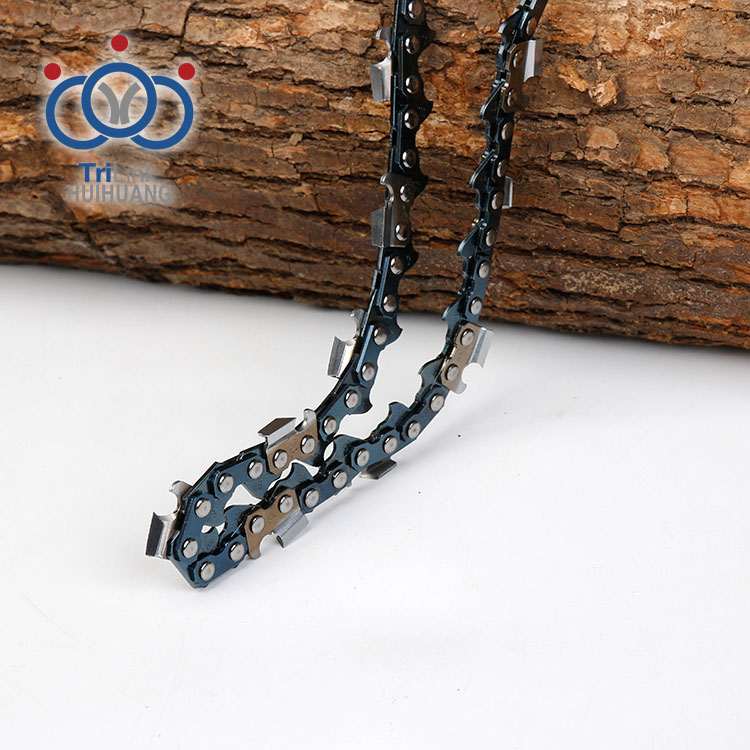
Understanding kickback is critical for operator safety. The chain you choose directly impacts the likelihood and severity of a kickback event. You must match the chain's safety rating to your experience level.
The kickback zone is the upper quadrant of the guide bar nose. If a cutter snags in this zone, the rotational force drives the bar violently upward and backward toward the operator. This happens in a fraction of a second, faster than human reaction time can stop it. The chain brake is your primary defense, but the chain design itself plays a massive role in prevention.
Chains are categorized by ANSI standards. The industry uses a color-coding system on the packaging. Green label chains are low-kickback and meet ANSI B175.1 standards. Yellow label chains are professional-grade and carry a high kickback potential. You should never ignore these labels.
Green-label chains feature ramped depth gauges and bumper drive links. These additions deflect branches and wood fibers away from the cutters as they pass around the kickback zone, preventing them from digging in too deeply. This makes bore cutting nearly impossible, but it drastically reduces the chance of the saw kicking back during normal bucking and felling.
Homeowners and occasional users must mandate low-kickback chains for their saws. Professionals opt for yellow-label chains to perform bore-cutting, plunge cutting, and achieve faster production rates. However, professional chains require mitigation steps, including specialized training, heavy-duty chainsaw chaps, and helmet systems with face shields.
Proper maintenance dictates the lifespan of your chain and guide bar. Neglecting tension or sharpness leads to poor performance and dangerous operating conditions. A dull chain forces you to push on the saw, which increases fatigue and the risk of accidents.
Perform the snap test to check tension. Pull the chain down from the bottom of the bar; it should snap back cleanly into the bar groove without sagging. Tensioning requirements differ between cold and hot chains. Always loosen a hot chain after use to prevent thermal shrinking from binding or damaging the crankshaft bearings.
Ensure the saw is turned off and the engine is cool.
Loosen the bar nuts slightly.
Lift the nose of the guide bar upward.
Turn the tensioning screw until the tie straps touch the bottom rails of the bar.
Perform the snap test.
Tighten the bar nuts while holding the bar nose up.
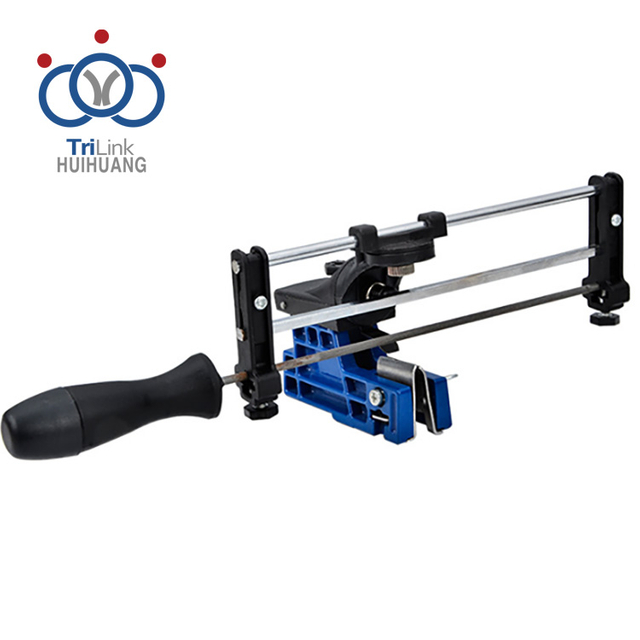
Sharpening requires matching the correct file type and diameter to the chain's specifications. Using the wrong file will ruin the cutting angle and destroy the chain.
Round files are standard for semi-chisel and full-chisel chains. They must match pitch sizes, commonly 5/32" for 3/8" low profile, 3/16" for .325", or 7/32" for standard 3/8".
Hexagonal files are required specifically for specialized Hexa grinds.
Flat files and depth gauge tools are mandatory for filing down rakers to match cutter wear as the tooth gets shorter over time.
You must replace your chain when it meets certain wear criteria. Running a worn-out chain damages the drive sprocket and the guide bar rails.
The cutter length is worn past the engraved witness mark on the top plate.
You spot broken, cracked, or loose drive links and rivets during inspection.
Uneven cutter lengths cause the saw to cut in a curve, and filing cannot correct it.
The chain sustains severe damage from striking metal or rocks that cannot be filed out safely.
Selecting the right chainsaw chain starts with matching the correct specifications to your saw and maintaining it properly throughout its service life. The right chain improves cutting efficiency, enhances safety, and helps protect your guide bar and powerhead from unnecessary wear.
Zhejiang TriLink Huihuang is a professional manufacturer of chainsaw chains, guide bars, and forestry cutting solutions. With advanced manufacturing technology, rigorous quality control, and extensive OEM/ODM experience, the company supplies reliable cutting products to forestry professionals, distributors, and outdoor power equipment brands worldwide.
Clean your guide bar with a wire brush to locate the stamped specification numbers for pitch, gauge, and drive link count.
Count your current drive links manually if the bar stamps are illegible, marking the starting link with a marker to avoid miscounting.
Check your powerhead displacement or battery voltage to determine if you need a standard-kerf or narrow-kerf setup.
Consult your manufacturer's compatibility chart before purchasing a new chain to ensure the drive sprocket matches your selected pitch.
A: Yes, brands are interchangeable as long as the pitch, gauge, and drive link count exactly match your saw's requirements. The guide bar and sprocket dictate these dimensions, not the brand name.
A: Look for the stamped numbers on the heel of your guide bar. If they are worn off, manually count the drive links and use a caliper to measure the gauge, or check the manufacturer codes stamped on the drive links.
A: The .325 pitch is smaller and lighter, typically used on mid-range saws under 55cc. The 3/8 pitch is larger, requires more power, and is standard on professional saws over 60cc. They require different drive sprockets.
A: Rapid dulling usually results from hitting dirt, rocks, or the ground. Using a full-chisel chain in abrasive conditions or cutting with incorrect depth gauge heights also causes premature edge loss.
A: These are manufacturer-specific ID codes that correlate to the chain's pitch and gauge. For example, Oregon uses specific numbering systems that you can cross-reference to find exact replacement specs.
A: It depends on the application. Full-chisel cuts faster in clean, green wood but dulls quickly in dirty conditions. Semi-chisel cuts slightly slower but stays sharp much longer when cutting dirty or frozen wood.